
EN 15182 is a series of European standards covering safety requirements, performance and test methods for hand-held firefighting nozzles. A documented certificate helps buyers verify which requirements have been assessed and which nozzle models and configurations are covered.
Flow rate, reach and weight all matter when choosing a nozzle. So does the ability to operate its controls with firefighting gloves and recognise its settings when visibility is poor.
What does EN 15182 cover?
EN 15182-1 sets out the common requirements for hand-held firefighting nozzles, also referred to as branchpipes in the standard. EN 15182-2 adds specific requirements for PN 16 combination nozzles, with maximum flow rates of up to 1,000 l/min at a reference pressure of 6 bar.
This reference pressure is used to assess hydraulic performance. It does not, by itself, determine the pump pressure required during an incident.
Operating controls with firefighting gloves
Firefighters need to open and close the nozzle, select the flow rate and adjust the spray pattern while maintaining control of a charged hose line. EN 15182-1 addresses operation while wearing firefighting gloves that comply with EN 659.
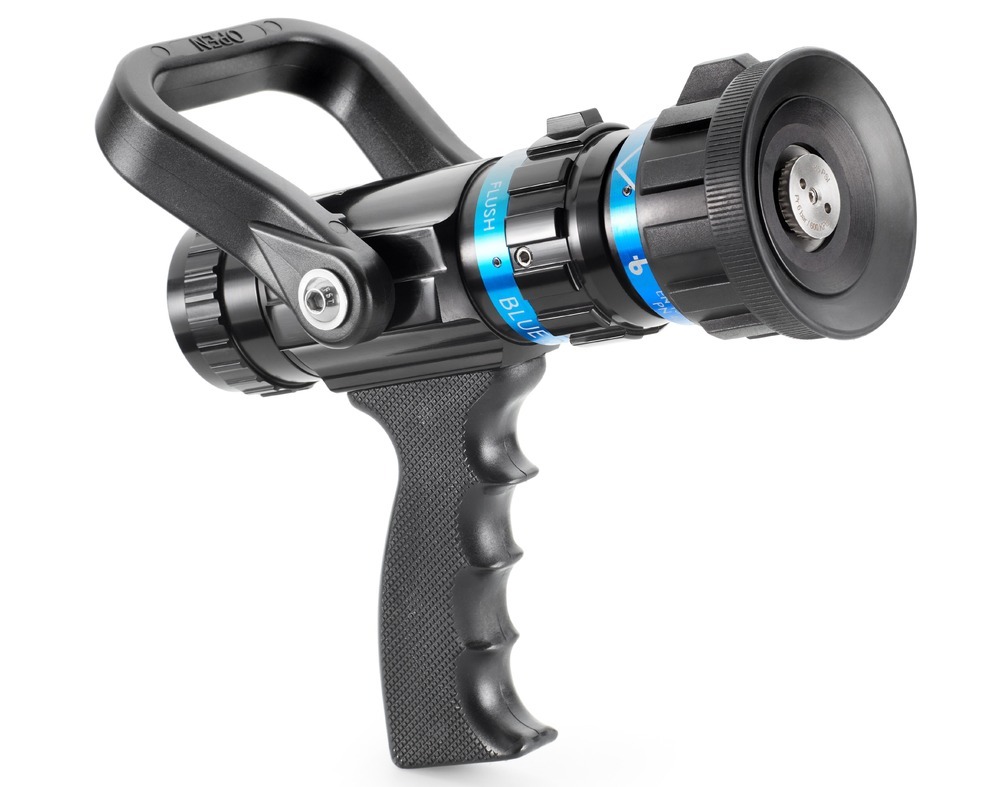
Where rotating controls are used, the maximum flow setting must be identifiable by touch, with the exception specified for type 1 nozzles. This gives the operator a reference when the markings are difficult to see.
Indexed positions, often felt as “clicks”, also help the operator recognise changes in settings. EN 15182-2:2019 includes checks on the force needed to move rotating controls with detents, both before and after repeated operating cycles.
Changing the spray pattern within a defined turn
EN 15182-2:2019 specifies the rotation needed to move from a straight jet to a wide spray pattern of at least 100°:
- 70° to 180° for nozzles with a maximum flow rate of up to 500 l/min.
- 70° to 270° for nozzles with a maximum flow rate above 500 l/min.
These limits allow the pattern to be changed within a defined movement of the control. The appropriate pattern during an incident depends on conditions and the fire service’s operating procedures.
Testing durability and hydraulic performance
The EN 15182 series includes heat, frost and drop tests, alongside hydraulic checks. These assess how the nozzle performs under defined test conditions.
For a type 3 combination nozzle, which has an adjustable pattern and selectable fixed flow rates, changing the pattern must not alter the selected flow rate at a given pressure.
When comparing nozzles, flow figures therefore need to be considered alongside the corresponding pressure and nozzle type.
What should you check on the certificate?
A manufacturer’s declaration of compliance and independent certification are different forms of evidence. Before selecting a nozzle, request the certificate and check:
- The model and configuration covered.
- The applicable parts and editions of the standard.
- The issuing organisation and scope of certification.
Review the technical data sheet and operating and maintenance instructions as well. Certification provides evidence about the equipment assessed; training, inspection and maintenance remain essential throughout its service life.
For selected VIPER BLUE DEVIL and VIPER ATTACK models, TIPSA Kuriyama states that certification to EN 15182-1 and EN 15182-2 type 3 is available on request.
Contact TIPSA Kuriyama for technical information and certification details for the model you are considering.
More info

Frequently asked questions
What is the difference between EN 15182-1 and EN 15182-2?
EN 15182-1 covers the common requirements for hand-held firefighting nozzles. EN 15182-2 adds specific requirements for PN 16 combination nozzles within its scope.
Why should firefighters be able to identify flow settings by touch?
Tactile references help firefighters identify settings in poor visibility without relying solely on visual markings. Operators should practise using the controls on their particular nozzle model.
Does EN 15182 certification replace maintenance?
No. Certified nozzles still require inspection, cleaning and maintenance in accordance with the manufacturer’s instructions.