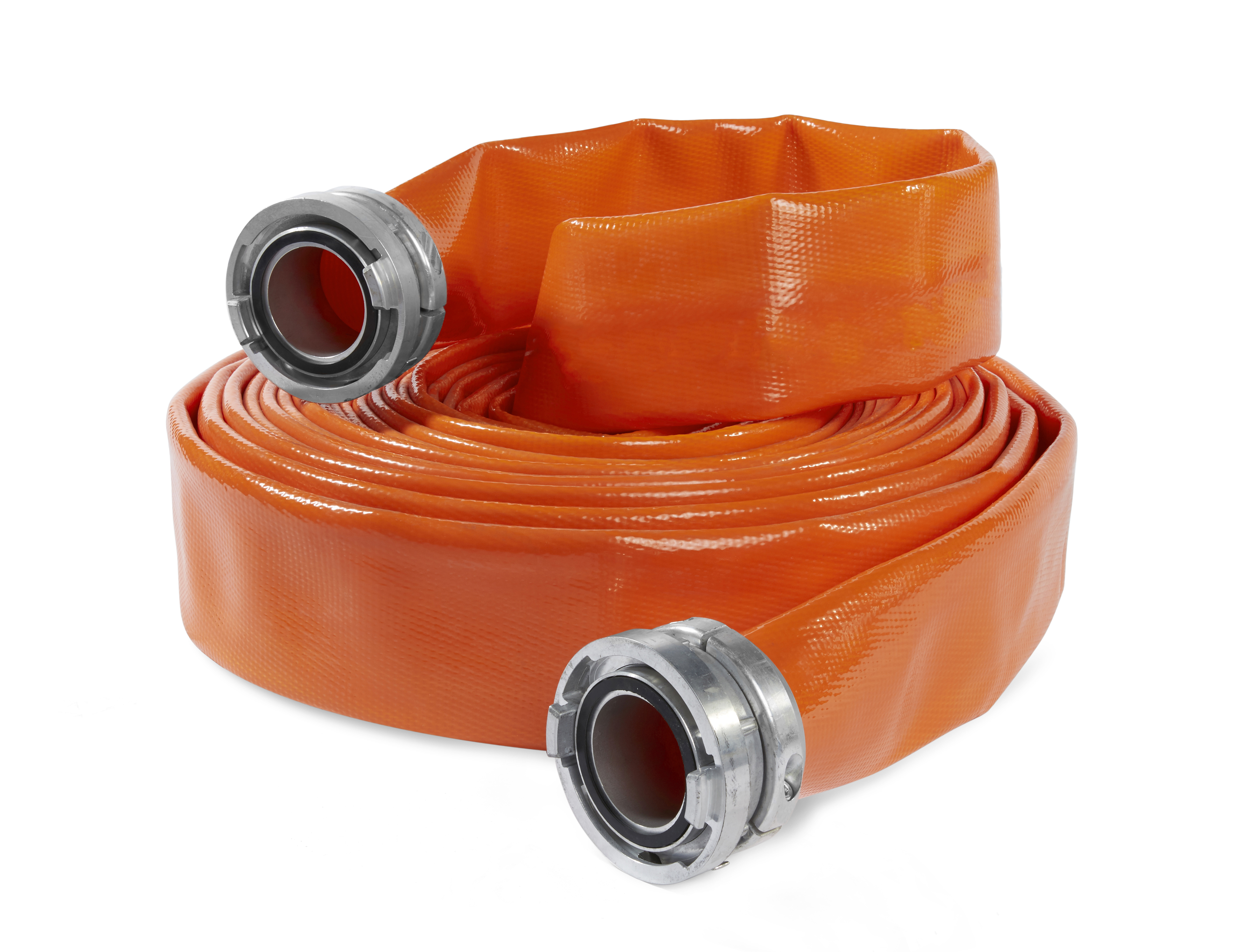
Drag layflat hoses used in manure handling, travelling irrigators and sludge transfer operate under conditions of continuous abrasion, repeated bending cycles and exposure to UV and ozone. These stresses make material selection and hose construction design critical for long-term performance.
The TIPSA Kuriyama Oroflex Drag series incorporates recent developments in TPU formulation to enhance abrasion resistance without altering wall thickness or hose weight.
Material Engineering: New TPU Rubber Formulation
A key aspect of the Oroflex Drag hose is the use of an in-house engineered thermoplastic polyurethane (TPU).
Unlike conventional approaches—where increased durability is usually achieved by increasing material thickness—TIPSA has developed a higher-resistance TPU compound that maintains:
- The same nominal wall thickness (3.9 mm or 4.4–4.6 mm depending on diameter)
- The same weight per meter
The objective of this formulation is to improve abrasion behaviour and cut resistance while preserving hose flexibility and handling characteristics.
Construction Characteristics
Oroflex Drag hoses are manufactured using:
- Circularly woven high-tenacity synthetic yarn
- TPU fully extruded through the weave, producing a monolithic structure without adhesives
This construction provides:
- Full encapsulation of the textile reinforcement
- Elimination of delamination risk
- Improved stability under expansion (max. 10%)
- No corrosion or scaling on the internal surface
The single-body extrusion process also contributes to low friction losses, which is critical for long-distance pumping operations.
Mechanical and Physical Performance
Tensile Strength
Depending on diameter, Oroflex Drag demonstrates tensile strengths ranging from:
- 13,100 N to 33,600 N for standard Drag
- Up to 42,000 N for Drag Extreme versions
These values indicate a consistent reinforcement-to-mass ratio, confirming that the improved TPU formulation contributes to performance without requiring additional mass.
Abrasion Resistance
TPU is recognised as one of the most abrasion-resistant elastomeric materials used in hose engineering. The enhanced formulation is aimed at further reducing wear during continuous dragging over rough surfaces, one of the main failure mechanisms in drag applications.
UV and Ozone Resistance
The hoses are rated for extreme UV and ozone exposure, showing no visible cracking under standard ozone testing conditions.
Thermal Behaviour
The service temperature range remains:
- –50°C to +65°C, with peaks up to 80°C
This range allows the hose to maintain flexibility in cold climates and mechanical stability under warmer liquid-transfer operations
Comparison: Oroflex Drag vs. Oroflex Drag Extreme
Both series share the same base TPU technology and construction design. The Extreme version incorporates reinforcement changes intended for highly abrasive environments, not by increasing thickness significantly but by adapting the internal reinforcement architecture.
Key comparative behaviour (from TIPSA's performance graph):
- Drag Extreme shows increased tensile strength
- Improved adhesion properties
- Higher abrasion resistance
- Similar flexibility and expansion characteristics
Operational Considerations
- Standard lengths: 100 m and 200 m
- Compatible with common agricultural couplings (Camlock, Bauer, Perrot, Storz, Victaulic)
- Designed for manure, irrigation lines, sludge injection, seawater/brackish water and wastewater transport
The hose’s behaviour under repeated cycles of drag and retrieval benefits from the stability and recovery properties of the TPU/yarn composite.